Standing Desk Converter Depth for a Small Desk
A standing desk converter fits a small desk safely when its base depth is close to the desk’s own depth — many compact converters measure 16 to 25 inches deep. As a practical rule of thumb, aim for a base depth at least 70% of your desk’s depth to avoid front-to-back rocking once the converter is raised to standing height.
By deskconverterguide.com Editorial Team · Last updated: November 13, 2026
Key takeaways
- Compact converter base depths run from about 16.3 inches (FlexiSpot AlcoveRiser M7) to 25.25 inches (Uncaged Ergonomics CHANGEdesk) across common models.
- There is no published engineering standard for a converter base-depth-to-desk-depth ratio. The ≥70% figure in this guide is this site’s own rule of thumb, not an official spec from any manufacturer or standards body.
- Measure your desk’s depth first, then compare it against a converter’s base-depth spec sheet before you buy.
- A converter that’s too shallow for your desk can rock front-to-back once it’s raised to standing height, even if it felt stable sitting flat in the box or at the seated position.
- Non-slip pads and checking wobble at full standing height help even a borderline-size converter sit more securely.
How do I measure my desk’s depth for a converter?
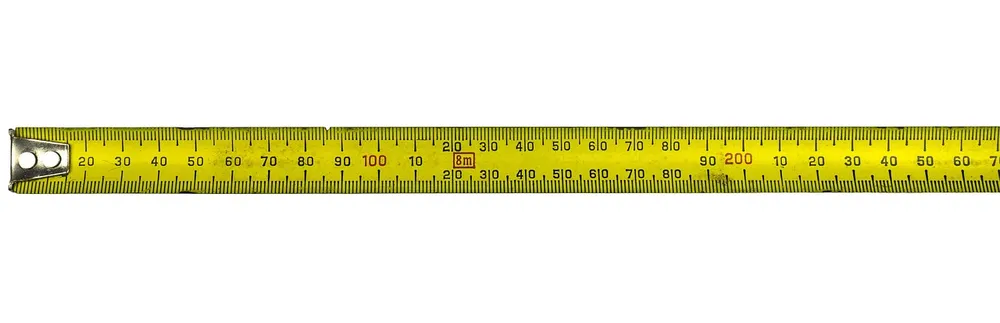
Use a tape measure to find the distance from the desk’s front edge (where you sit) to its back edge, in inches. Measure the usable flat surface only — skip any raised lip, monitor shelf, or hutch that isn’t part of the flat work area.
Many small or corner desks run roughly 18 to 24 inches deep, while standard office desks commonly measure 24 to 30 inches deep. Your own desk may fall outside that general range, so measure it directly rather than assuming a size category.
What is the base-depth-to-desk-depth ratio rule of thumb?
No converter-specific engineering standard publishes an exact base-depth ratio. The ANSI/BIFMA X5.5 standard for office desks and tables does include a stability and tip-over test using a concentrated edge load, and a 2021 revision added a specific test for units with monitors attached — but the standard is written for office desks and tables generally, not standing desk converters, and no publicly readable version states a specific base-depth percentage.
The 70% figure used on this site is our own practical guideline, loosely inspired by the general furniture-design principle that a base needs to stay under the center of gravity of whatever sits on top of it. It is not a tested or certified number from BIFMA, any manufacturer, or any standards body. Treat it as a starting point, not a guarantee.
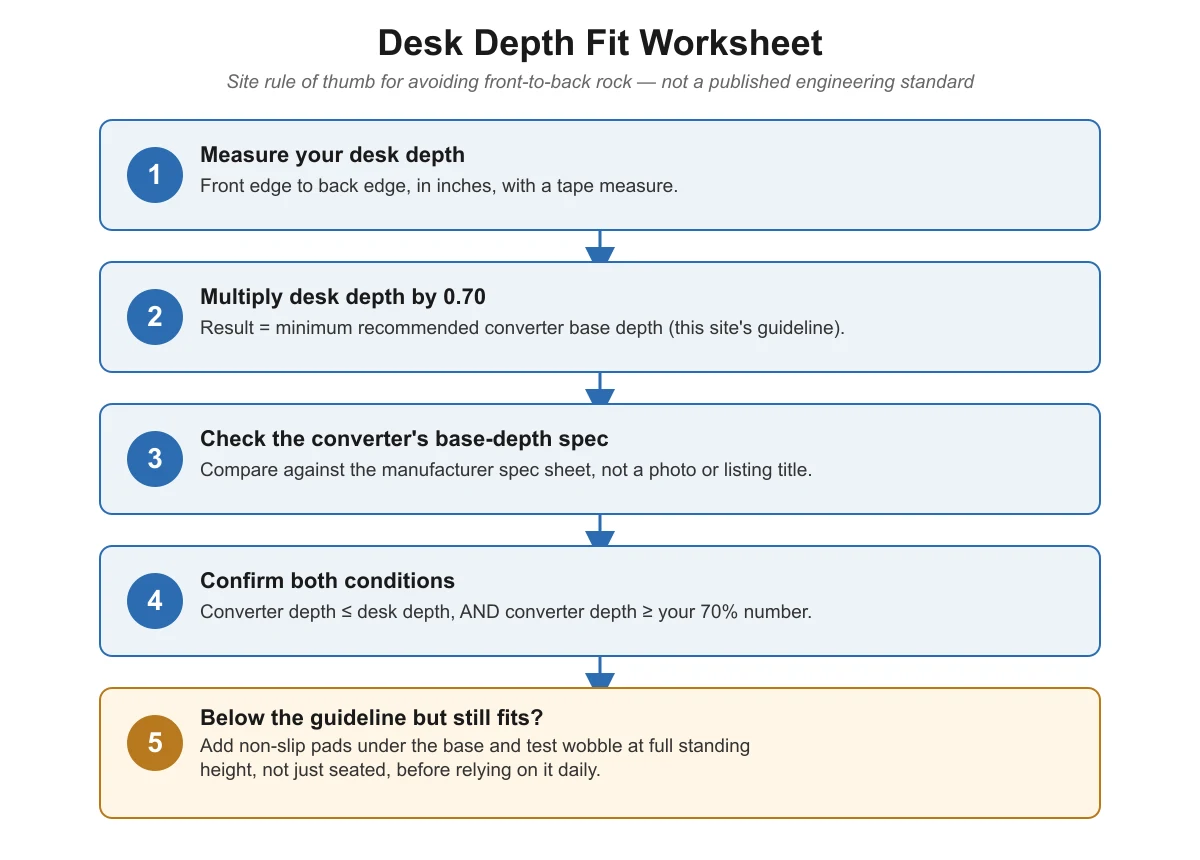
The formula: multiply your desk’s depth by 0.70 to get a minimum recommended converter base depth. For example, a 24-inch-deep desk suggests looking for a converter with a base depth of at least about 16.8 inches.
How deep are popular standing desk converters?
Manufacturer spec pages list base or platform depth differently — some give a single work-surface depth, others give a base footprint. Check the specific number on the product page before buying, since “compact” branding doesn’t always mean a shallow base.
| Model | Base/platform depth | Weight capacity | Mechanism |
|---|---|---|---|
| FlexiSpot AlcoveRiser M7 | 16.3″ (work surface) | 37.4 lbs combined | Gas spring |
| Eureka Ergonomic 36″ converter | 22″ overall | 35 lbs (30 display + 5 tray) | Gas cylinder |
| Mount-It MI-7927E | 23.22″ | 44 lbs combined | Electric |
| Mount-It MI-7962 | 23.25″ | 44 lbs combined | Electric |
| VersaDesk PowerPro (36″x24″) | 24″ | 80 lbs | Electric |
| Uncaged Ergonomics CHANGEdesk | 25.25″ (base footprint) | 30 lbs | Gas-spring, fixed positions |
What if my desk is shallower than a converter’s base depth?
You have a few options. Look for a converter with a shallower base depth spec that still meets the 70% guideline above. Consider a clamp-on mounting style, which attaches to the desk’s edge instead of resting fully on the surface — see our clamp-on vs. desktop mounting guide for the desk-compatibility checks that style requires.
Whatever you choose, never let the converter’s base overhang the desk’s front edge. An overhanging base has less of its footprint actually supported by the desk, which makes tipping more likely regardless of the ratio guideline.
Step-by-step measuring worksheet
Work through these steps before you buy:
- Measure your desk depth front-to-back with a tape measure, in inches.
- Multiply desk depth by 0.70 (this site’s own stability guideline, not a published standard) to get your minimum recommended converter base depth.
- Check the converter’s spec sheet for its own base or platform depth (see the table above for examples).
- Confirm the converter’s depth is less than or equal to your desk’s full depth, so it won’t overhang the front edge, and at or above your 70% guideline number.
- If it’s below the 70% guideline but still fits within your desk’s depth, plan to add non-slip pads and check wobble carefully at full standing height before relying on it daily.
Does a shallower converter always wobble?
Not necessarily. Base depth is one factor among several. Mounting type, bolt tightness, and desk surface flatness all affect stability too. See our clamp-on vs. desktop mounting guide for how mounting style changes the stability equation, and our wobble troubleshooting guide for a full fix checklist if a converter you already own is rocking.
For a wider view of how base depth fits into the rest of the buying decision — weight capacity, mechanism type, and mounting — start with our standing desk converter buying guide or compare the three main platform types in our converter types comparison.
Frequently asked questions
What is a good base depth for a standing desk converter on a small desk?
Manufacturer base depths for compact models range from about 16.3 inches (FlexiSpot AlcoveRiser M7) to 25.25 inches (Uncaged Ergonomics CHANGEdesk). Match the spec to your own desk’s depth rather than picking by a “compact” label alone — a converter marketed as compact can still be too deep for an 18-inch desk.
Is the 70% base-depth ratio an official standard?
No. No standards body publishes a specific base-depth-to-desk-depth ratio for standing desk converters. The 70% figure is this site’s own practical guideline, inspired by general furniture stability principles, not a tested or certified number from BIFMA or any manufacturer.
Can I use a standing desk converter on a desk deeper than the converter’s base?
Yes. A converter with a base shallower than your desk’s full depth is generally fine as long as it doesn’t overhang the front edge and sits flat on the surface. The concern addressed in this guide is the opposite case — a converter base that’s too shallow relative to the desk invites front-to-back rock at standing height.
Does a keyboard tray change the depth I need?
Yes, a keyboard tray adds its own depth requirement, since it usually slides out toward you. Check the tray’s own depth spec — for example, Eureka Ergonomic’s 36-inch converter has a keyboard tray that adds roughly 16.875 inches — against your available knee and seating clearance, separately from the base-depth-ratio question covered here.
Sources
- VersaDesk PowerPro product specifications
- FlexiSpot AlcoveRiser M7 product specifications
- Mount-It MI-7962 product specifications
- Mount-It MI-7927E product specifications
- Uncaged Ergonomics CHANGEdesk product specifications
- Eureka Ergonomic 36″ converter specifications (authorized dealer spec page)
- Eureka Ergonomic: BIFMA office furniture safety tests
- Woodworking Advisor: general furniture base-to-top stability principles