Electric vs. Manual Standing Desk Converter: Which to Buy
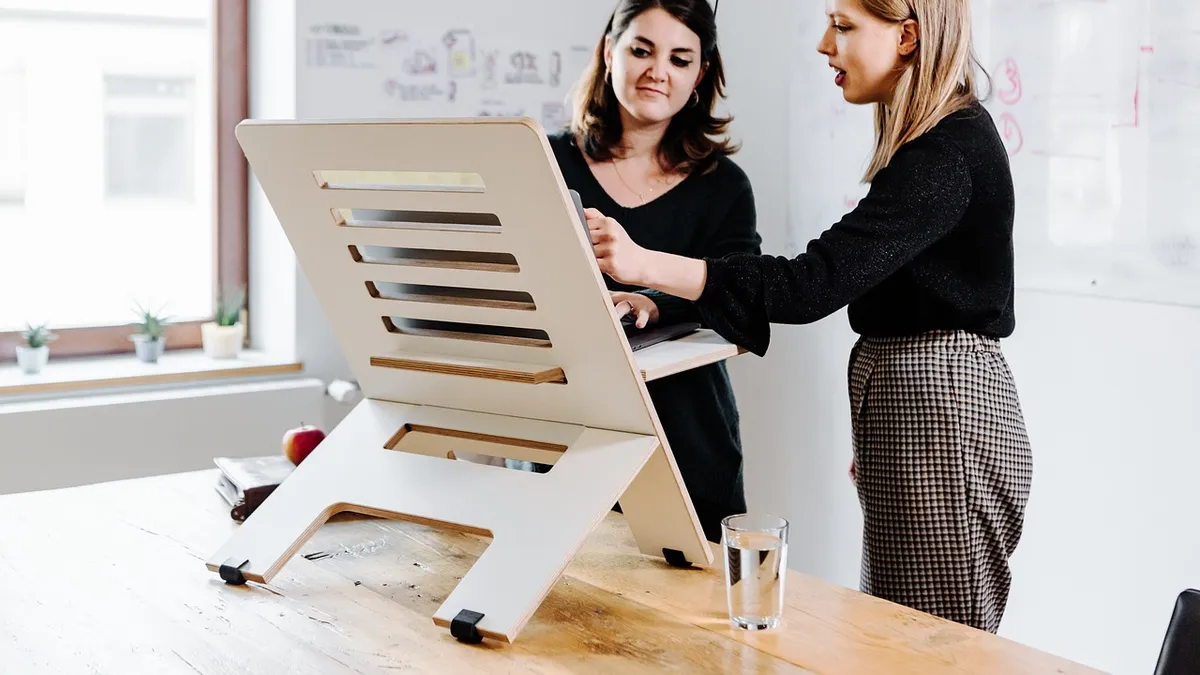
An electric standing desk converter raises and lowers at the push of a button, while a manual converter uses a gas-spring mechanism and a release lever (or fixed height positions) that you operate by hand. Electric models are faster and require less physical effort per change, which matters most if you switch between sitting and standing several times a day; manual models are typically simpler and have fewer parts that can fail electrically.
- Key takeaways
- Electric converters use a motor and a button; manual converters use a gas-spring mechanism with a release lever, or fixed height positions you set by hand.
- The more times per day you plan to change position, the more the electric motor’s convenience pays off.
- Real electric models in our research include VersaDesk’s PowerPro and Mount-It’s MI-7962 and MI-7927E; real manual (gas-spring) models include FlexiSpot’s AlcoveRiser M7 and Uncaged Ergonomics’ CHANGEdesk.
- We found no manufacturer-published prices broken out by mechanism type, so a precise dollar break-even isn’t possible with sourced data — use the transitions-per-day framework below instead.
- Manual converters with fixed positions (like the CHANGEdesk) don’t let you fine-tune height between the preset stops.
How does each mechanism actually work?
An electric converter has a motor that raises and lowers the platform when you hold or tap a button — no physical effort beyond pressing it. VersaDesk’s PowerPro, for example, is a push-button electric converter rated for 80 lbs that rises to 20″ with no preset stops, so you can stop at any height within its range. Mount-It’s MI-7962 and MI-7927E are also electric, each rated for 44 lbs combined, with height ranges of roughly 6″-19.25″ and 6.3″-19.3″.
A manual converter typically uses a gas-spring cylinder: you pull or press a release lever, and spring tension does most of the lifting work while you guide the platform to the height you want. FlexiSpot’s AlcoveRiser M7 is a real example — gas-spring, rated for 37.4 lbs combined, with a continuous height range of 4.7″-20.1″ and an “X-lift” frame marketed for anti-tip stability. Uncaged Ergonomics’ CHANGEdesk is also gas-spring-assisted, but instead of continuous adjustment, it locks into five fixed positions (4.1″, 10″, 15.4″, 18.75″ and 21.25″).

How many daily transitions justify paying for electric?
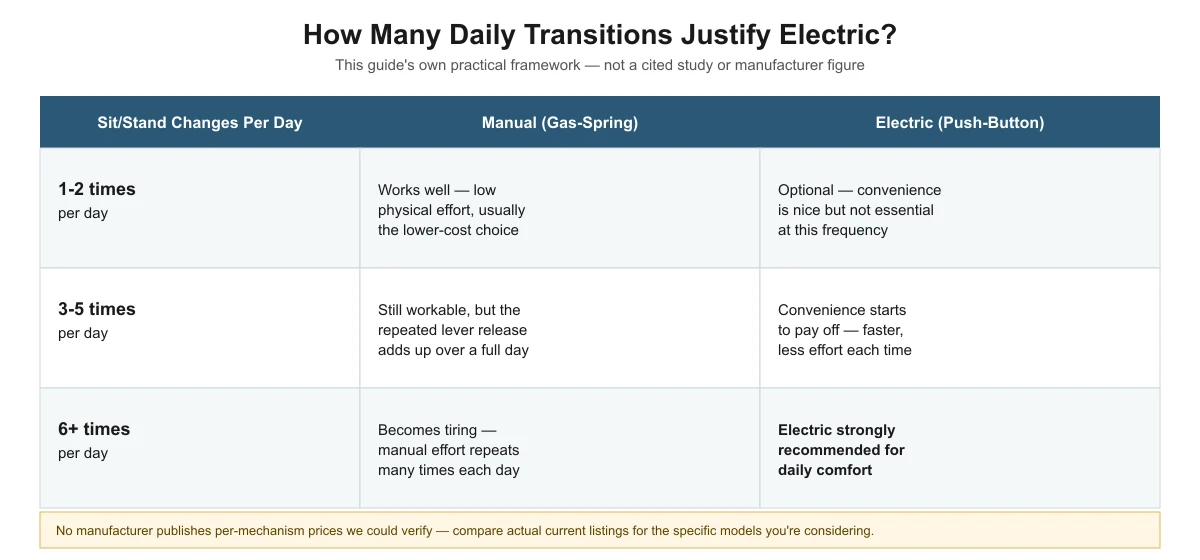
We could not find manufacturer-published prices broken out by mechanism type — product pages we checked list specs, not consistent retail pricing, so a precise dollar break-even isn’t possible with the sourced data in this guide. Instead, use how often you actually plan to change position as the deciding factor.
| Sit/stand changes per day | Manual (gas-spring) | Electric (push-button) |
|---|---|---|
| 1-2 times | Works well — low physical effort, usually the lower-cost choice | Optional — convenience is nice but not essential at this frequency |
| 3-5 times | Still workable, but the repeated lever release adds up over a full day | Convenience starts to pay off — faster, less effort each time |
| 6+ times | Becomes tiring — manual effort repeats many times each day | Electric strongly recommended for daily comfort |
This framework is this guide’s own practical reasoning, not a cited study or manufacturer recommendation. Before buying, check the actual current price of the specific electric and manual models you’re comparing — that real-world price gap, divided by how many years you expect to keep the converter, is the number that matters for your own budget.
What else differs besides speed?
Electric converters have a motor and internal electronics, which is one more component that can eventually fail compared to a purely mechanical gas-spring system. Manual converters have fewer electrical parts, but the gas-spring cylinder itself is a wear part that weakens over years of use — we found no data on exactly how long a specific gas-spring cylinder or electric motor lasts on its own, only whole-product lifespan estimates (see our converter vs. full desk cost comparison for those figures).
Fixed-position manual converters, like the CHANGEdesk, also trade fine height control for simplicity — you choose from a set number of stops rather than any exact height. If precise height adjustment matters to you, a continuous-adjustment model (electric or gas-spring) fits better than a fixed-position one.
Which should you buy?
If you change position only once or twice a day, a manual gas-spring converter does the job without the extra cost of a motor. If you switch several times a day, or you want to fine-tune height exactly rather than use fixed stops, electric is worth the premium for most people. Either way, check the weight capacity against your own setup first — see our weight capacity guide — since capacity varies by model regardless of mechanism.

Do extra features like USB charging matter?
Some electric models bundle in small conveniences beyond the lift itself. VersaDesk’s PowerPro includes USB charging built into the platform, and Mount-It’s MI-7927E is also sold with USB charging as a named feature. Gas-spring models in our research, including the FlexiSpot AlcoveRiser M7 and the Uncaged Ergonomics CHANGEdesk, are not advertised with this feature on the pages we checked. If charging your phone or accessories at your desk matters to you, it’s worth checking for on the specific electric model’s product page — it’s a per-model feature, not something guaranteed across every electric converter.
Frequently asked questions
Are electric standing desk converters noisy?
We found no manufacturer-published noise-level data for the specific models in this guide, so we can’t give a verified number. In general, a motor makes some operating sound during a lift, while a gas-spring release is typically quieter but may make a brief mechanical click when releasing the lever.
Do manual converters require more strength to operate?
Gas-spring mechanisms are designed so the spring does most of the lifting work — you mainly guide the platform and manage the release lever, rather than lifting the full weight yourself. It still takes more physical action per change than pressing a button.
Can a manual converter still hold two monitors?
Yes, if its weight capacity covers your setup. FlexiSpot’s AlcoveRiser M7, a manual gas-spring model, is rated for 37.4 lbs combined — check your actual monitor weights against that figure using our weight capacity guide.
Is a fixed-position converter a type of manual converter?
Yes — fixed-position models like the Uncaged Ergonomics CHANGEdesk are gas-spring-assisted but stop only at a set number of heights, rather than adjusting continuously like the FlexiSpot AlcoveRiser M7 or electric models.
Sources
- VersaDesk PowerPro product page — electric mechanism, weight capacity, height range
- Mount-It MI-7962 product page — electric mechanism, weight capacity, height range
- Mount-It MI-7927E product page — electric mechanism, weight capacity, height range
- FlexiSpot AlcoveRiser M7 product page — gas-spring mechanism, weight capacity, height range
- Uncaged Ergonomics CHANGEdesk product page — gas-spring mechanism, fixed height positions, weight capacity
deskconverterguide.com Editorial Team
Last updated: November 13, 2026